
Amherst City Directory Collection Shelf
The Town of Amherst did not publish one continuous modern town directory. Amherst research instead uses a stack of Erie County, suburban, Buffalo, and local-history material. For Amherst names, the Buffalo & Erie County Public Library city-directory guide is the best starting point for verified runs and call numbers. Its holdings must be read with the place heading in view. A Buffalo listing is strongest for Buffalo proper, while the county and suburban series are the more direct route to Amherst-area households.
| Collection | Years | Where Held | Access |
|---|---|---|---|
| Buffalo & Erie County Register and Business Directory | 1870 | B&ECPL Special Collections | Directory guide and in-person collection; includes Amherst farmers and town material. |
| Erie County directory | 1916/17 and 1917 | B&ECPL | Call numbers appear in the directory guide; check Amherst county and place headings. |
| Erie County Suburban | 1949 | B&ECPL | In-person Amherst suburban household and address layer. |
| Buffalo Northeast Suburban | 1957, 1958, 1960–64, 1966–80 | B&ECPL | In-person runs for Amherst-area places with documented missing years. |
| Buffalo Suburban | 1983–present | B&ECPL; New York State Library film for 1983–92 | Later Amherst suburban and reverse/address-style research. |
| Buffalo Address Book and Family Directory | 1883–1916 | NY Heritage; Buffalo History Museum | Digitized pages for regional context; verify an Amherst connection. |
| Amherst Bee and Amherst tax rolls | 1879–2012; 1854–1900 | BNHV Amherst Library and Reading Room | Appointment-based microfilm and local-history research. |
Gaps are part of the Amherst evidence. The Northeast Suburban run skips years, and a surname absent from a volume may reflect coverage, editorial practice, or the person’s omission rather than an Amherst departure. The library guide also directs researchers to Eggertsville, Snyder, and Williamsville runs. Those place labels can be useful when an Amherst household was described by a mailing community rather than the town name.
Note: A directory entry is a dated household lead, not a complete list of every person at an Amherst address.
Amherst’s 1870 Farmer Directory
The 1870 Buffalo & Erie County Register and Business Directory, published by C.C. Drew of Rochester, supplies an earlier route into rural Amherst. Its farmer and business material is arranged by town, which is important before numbered suburban streets became the usual directory language. A person from the Town of Amherst may therefore appear under a town or farm heading instead of a modern street address. For Amherst, the separate Erie County runs for 1916/17 and 1917 create another county-wide bridge, but their headings still need careful reading.
The digitized Buffalo Address Book and Family Directory collection makes it possible to inspect regional address and family-directory pages online before comparing them with Amherst sources.
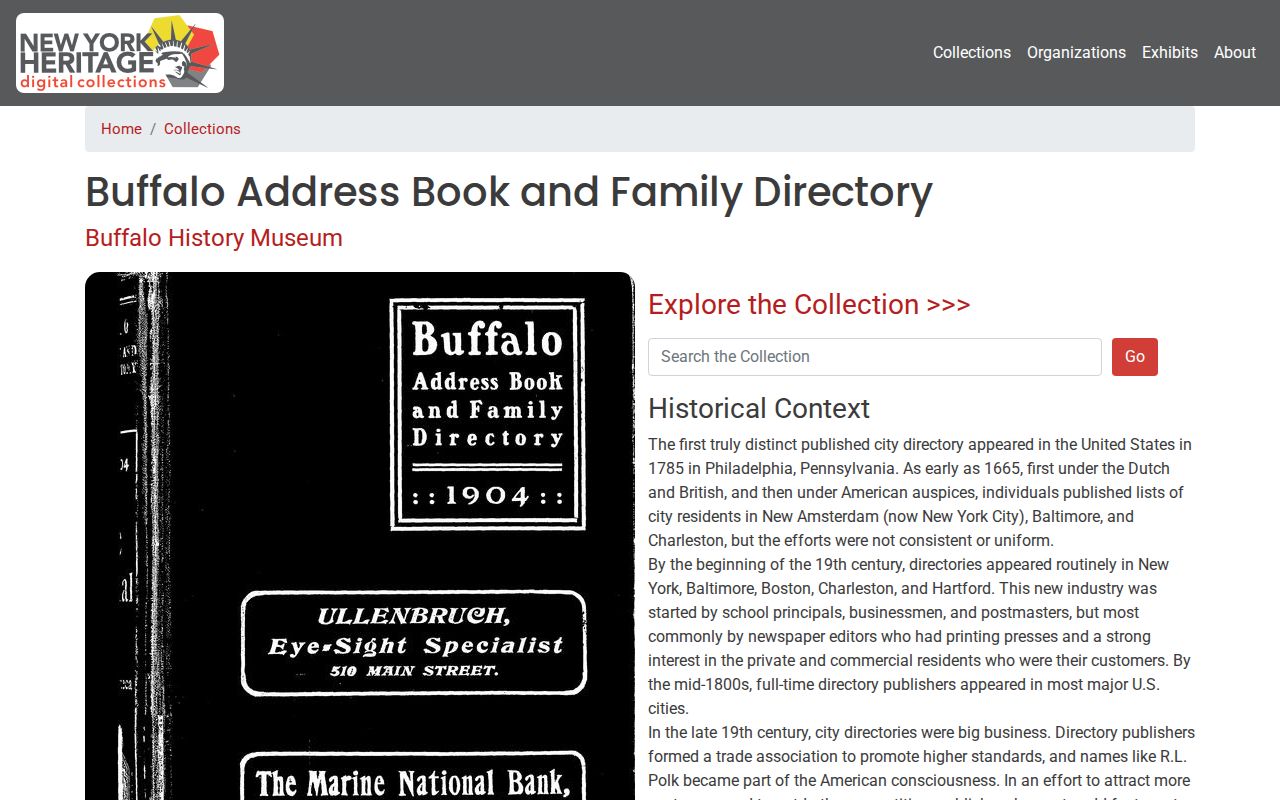
Its 1883–1916 volumes are useful for understanding the surrounding directory format, including family and reverse sections, but they must not be treated as automatic proof of Amherst residence.
BNHV’s Amherst Bee and Tax Rolls
For the most Amherst-specific historical layer, use Buffalo Niagara Heritage Village’s Amherst Library and Reading Room at 3755 Tonawanda Creek Road, Amherst, NY 14228. The collection reports Amherst Bee microfilm from 1879 through 2012, selected census and church records, directories, indexes, subject files, and Amherst tax rolls from 1854 through 1900. Research visits are appointment-based and generally use one-hour slots; self-guided research is free. The library can be reached at (716) 689-1440 or library@bnhv.org.
The BNHV Amherst Library and Reading Room collection page identifies the local newspaper, directory, census, church, and tax material available there.
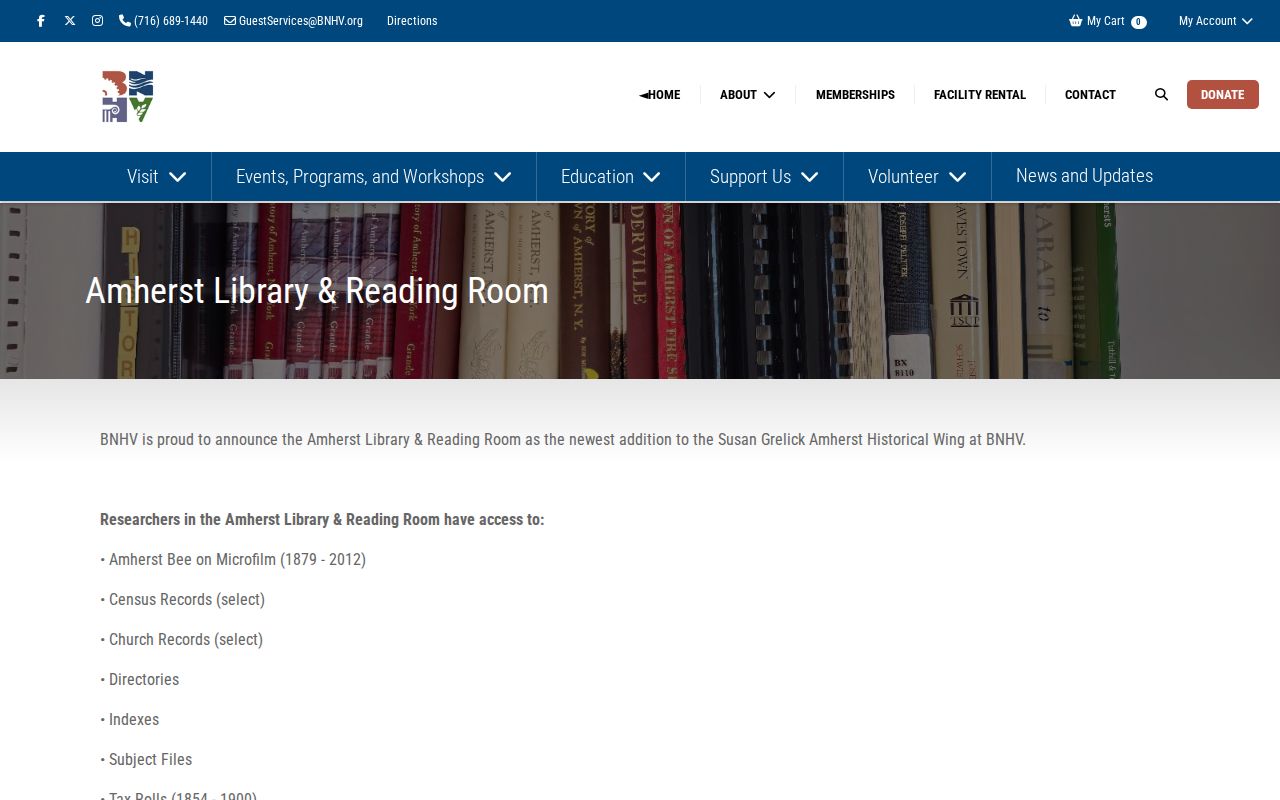
BNHV connects an old Amherst name to local chronology when a published directory stops. Its indexed Amherst Bee articles and subject files can also help explain an Amherst hamlet, road, school, church, or institution named in a volume.
The room also holds Sue Miller Young’s A History of the Town of Amherst, New York, 1818–1965. That Amherst history helps locate the next source, but a deed, census page, newspaper item, or tax-roll entry remains the record needed to test a claim about a specific household.
Amherst Directory Access in Buffalo
Two Buffalo institutions provide the broader Amherst shelf. B&ECPL Special Collections offers city directories, federal census material, some state censuses, church and cemetery sources, obituaries, and local-history guidance. Its genealogy databases include Ancestry Library Edition for in-library use and HeritageQuest at a library or from home with a B&ECPL card. HeritageQuest adds digitized census schedules, local and family-history books, U.S. city directories, and Sanborn Maps of New York. Amherst researchers should check current remote-login terms with the library.
Buffalo History Museum library collections add telephone, city, suburban, social, business, alumni, church, professional, nonprofit, and membership directories, plus an obituary index that reaches roughly 1812–1985. For Amherst research, the museum is at 1 Museum Court in Buffalo, maintains the FRANK catalog of more than 30,000 works, and offers limited appointment-based research. Its collection page lists a $15 nonmember visit and free access for members. Newspaper microfilm extends from 1811 through 2012, with Buffalo papers from 1811 through 1963 available through Newspapers.com in the building.
The Buffalo History Museum library collections provide the historical directories, obituary index, catalog, and newspaper resources used for Amherst-area research.
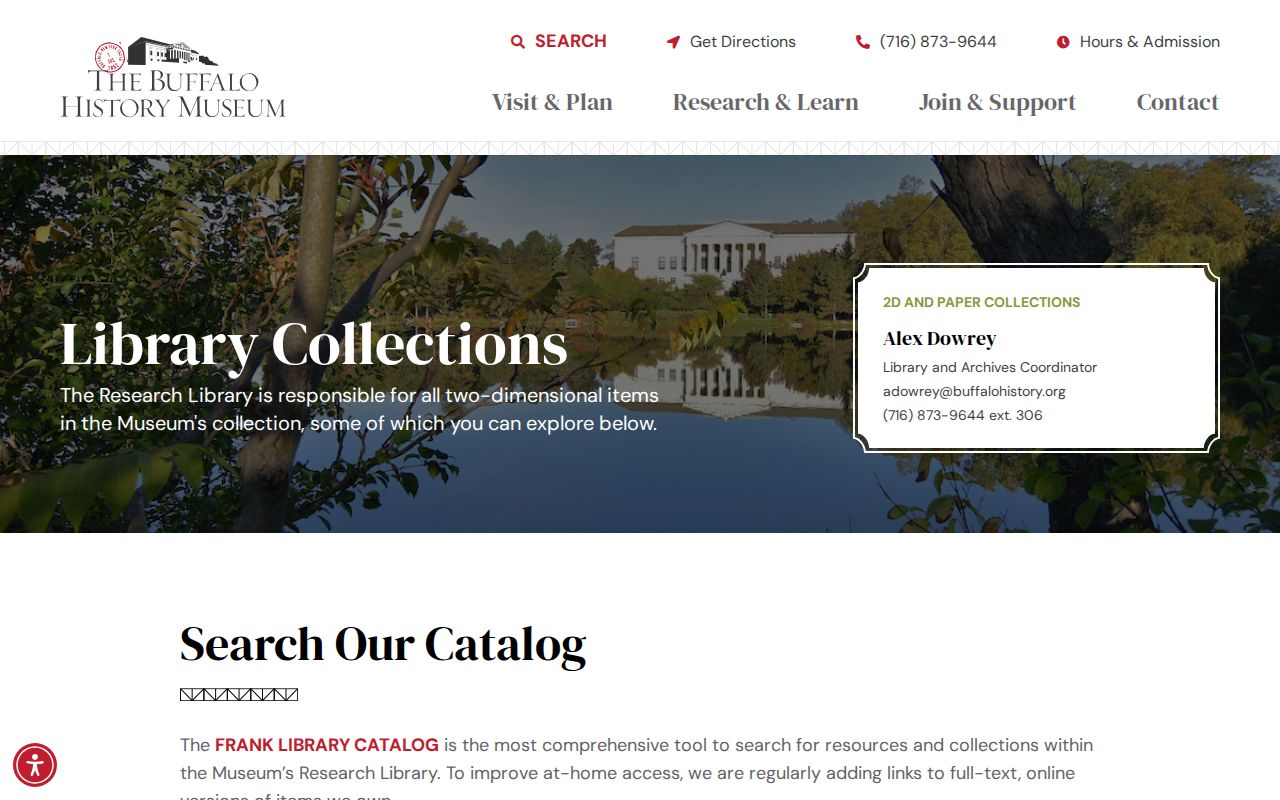
The museum complements, rather than replaces, the Amherst room: its books can show how an Amherst household or street was printed in a given year, while BNHV supplies the closer local newspaper and tax-roll trail.
Reading an Amherst City Directory Entry
Read the page heading before reading the name. Later Buffalo and suburban volumes may show a name, spouse or family notation, occupation or business, work affiliation, street address, and marks for an owner, occupant, or widow. For Amherst work, the exact abbreviations change by publisher and year, so the key at the front or back of that volume matters. The Buffalo Address Book collection cautions that directories can favor adult men, later add widows, single women, or students, and sometimes mark owners or occupants. Minors often do not appear in Amherst directory entries.
| Name as printed | Record initials, abbreviations, and spelling variants exactly as the volume gives them. |
|---|---|
| Town or suburb heading | Shows whether the entry belongs in an Amherst-area section rather than Buffalo proper. |
| Occupation or affiliation | May identify a business, profession, employer, or other printed association. |
| Street information | Later volumes can give an address; the 1828 regional sample uses streets without modern house numbers. |
| Family or status notation | Some later runs print a spouse, owner or occupant mark, or widow notation; inspect that volume’s key. |
- Criss-cross directory
- A reverse section that starts with an address or street and then identifies the listed occupant or household.
- Householder index
- A name-oriented list focused on the household head, which can omit children and other residents.
- Abbreviation key
- The publisher’s explanation of marks and shortened terms; use the key from the same directory year.
Label the result for what it is: a directory occupant, a tax owner, a recorded party, a voter, or an obituary subject. A city directory can suggest residence, but title should be tested against assessment and recorded-deed evidence. For that present-day address work, use the Amherst street directory path rather than treating an old listing as a current parcel record.
1828 Lessons for Amherst Directories
The 1828 Buffalo directory is a field guide to entry mechanics, not an Amherst resident list. It prints household heads as of January 1, 1828 and can give an occupation or business street separate from a dwelling street. The sampled entries have no consistent spouse-in-parentheses field and no modern house numbers. For Amherst research, that regional format shows why a bare old street string needs context before it is matched to a current Amherst address.
Its introduction says Buffalo roads had recently been renamed and notes an 1813 attack and fire. Those facts belong to Buffalo, not to an Amherst courthouse story. The useful Amherst method is narrower: compare the directory heading, historic maps, BNHV subject files, assessment legal descriptions, and GIS street layers when an address seems to change. A street mismatch can be a record-language problem, not proof that a household vanished.
Trace Amherst City Directories by Census
Begin with the nearest directory year that contains a known surname and address. Keep each change in an Amherst household as a hypothesis rather than a conclusion. A first name may expand, a spouse may appear, an occupation may shift, a family may move, or a widow notation may appear. Then compare the same surname and spelling variants in adjacent available volumes. Pair that sequence with the closest federal census year and use newspaper or deed evidence to test the Amherst household trail.
- Find the closest verified directory entry and copy the page heading, printed name, address, and all marks.
- Check adjacent available county or suburban volumes, including alternate surname spellings and nearby Amherst-area place headings.
- Use a reverse or criss-cross section, when present, to see the address-first listing for that year.
- Compare the household to the nearest public federal census schedule, which is available through 1950, and assess relationships there.
- Test a move, death, or estate transition with Amherst Bee material, the museum obituary index, and the recorded deed chain.
The 1890 federal census was largely destroyed in a 1921 Department of Commerce fire, so directories, tax rolls, newspapers, and deeds are especially important across that gap. The 1950 name index is OCR and AI-assisted, which means enumeration-district browsing may recover a missed name. When an old listing needs a current-person confirmation, the Amherst resident lookup process uses separate modern sources rather than extending the directory beyond its date.
Amherst Directory Years and Gaps
Amherst directory history is a series of separate publications, not an unbroken timeline. The dates below explain why an Amherst search may jump between collections. They also show why a precise year should be preserved in notes. The current online record environment is different again: the Erie County Clerk’s land index begins in 1986, although the deed series reaches back to 1808. A historical household search often has to leave the online index and move to books, microfilm, or a clerk request.
- 1828: The earliest regional Buffalo directory sample lists household heads, activities, and streets.
- 1870: The Buffalo and Erie County register adds farmers and town-level material useful for rural Amherst.
- 1949: Erie County Suburban supplies a distinct postwar suburban volume.
- 1957–1980: Buffalo Northeast Suburban appears in documented runs with missing years.
- 1983–present: Buffalo Suburban provides a later suburban series, with New York State Library film documented through 1992.
Erie County was organized in 1821, and Amherst became a town in 1818. No official source reviewed verifies an Amherst courthouse fire, flood, or local records disaster. The documented problem is access: online land indexing begins later than the deed series, directories have gaps, and individual census schedules after 1950 remain closed under the 72-year rule. When no online hit appears, the BNHV room, B&ECPL, museum, Erie County Clerk, and New York State Archives catalog are the practical fallback chain.
Town archival material is another local channel when a specific municipal series is not online. Amherst lists archives hours of 8:30 to 4:00 at the municipal building, but an itemized online catalog was not located. Ask the Town Clerk for the series or submit the Amherst FOIL request form for a specific nonexempt record. New York’s Freedom of Information Law is Public Officers Law Article 6, sections 84 through 90; FOIL does not make restricted vital or court records public.
Amherst Directory Names and Places
Older directories and deed indexes reward flexible name searching. Given names can be abbreviated, house numbers can be absent, street strings can change, and a spouse may be printed in parentheses or a widow notation. Keep the original spelling, then search sensible variants. The 1828 sample itself uses forms such as Benj and Philander, and the Town’s property search recommends beginning an owner query with a surname.
Place names need the same care. Amherst, Williamsville, East Amherst, and Getzville are not interchangeable geographic claims. A Williamsville mailing line does not necessarily mean that a parcel lies in the Village of Williamsville. For an address question, compare the directory heading with the assessment situs, Erie County GIS municipality, and section-block-lot number. For a historical household, record the printed place label first and avoid silently converting it to a modern address.